Get in touch Contact us here
Welcome to abernyte.org

Welcome to Abernyte

A community website bringing you news and information from Abernyte
Follow us:
  • Home
  • Community Company
      • Back
      • Abernyte Resilience
      • Abernyte Air Quality
      • Abernyte History
  • Gallery
  • Buy Abernyte Books
  • Air Quality
      • Back
      • Air Quality Data
  • Abernyte Nature
      • Back
      • Nature Reports
      • Nature Sightings
      • Air Quality Sensors
      • Abernyte Weather

Made in Abernyte...

...and stayed in Abernyte.

A fascinating glimpse from our past in Abernyte is provided by John Shabishow who uncovered some wonderful artifacts while renovating the old school building at the Schoolhouse. The original school in Abernyte was a single story building dating to the early 1700's which was adjacent to the single storey schoolhouse for the school master. Both buildings are likely to have had thatch or turf roofing as was the norm for that period. In 1824 the Schoolhouse was renovated with an extra storey added and a slate roof. It is nearly certain that the school had a new slate roof added at this time too.

At some point after the new works had been completed a number of artifacts were placed into the roof space where they have laid undisturbed, perhaps for 200 years,  until recently. 

Meet a pair of "rovies"

rovies

It was a well established tradition, at the time, with people working in the jute and flax mills to collect and bring home small scrap pieces of primarily jute. This was hand processed into strands that could be knitted or crocheted into slippers for children and were known in the Dundee jute mills as "rovies". Our "rovies" are made from interwoven strips of linen. In this period handloom weaving of linen was a staple cottage industry so it is very likely that these linen rovies were made from discarded strips from the hand loom process.

Shoes that were made to last. Abernyte had it's very own master shoemaker, William Whittet and his family who lived at Balfour Cottage from the early 1800's with his father or possibly grandfather, Peter Whittet working as a handloom linen weaver in the adjoining Bield.  In those days a pair of shoes would be reused and repaired and passed down all of the children or family that they could fit.

shoes adult       shoes adult 2

It is easy to note how oft repaired these shoes were and how neatly they were made. The shoes did not have to be wholly functional as a pair of rather snazzy slip on models were also found!

shoes slipon 


The hand working skill was not limited to shoe making as, what we assume is a beautiful reversable cuff from a girls dress was also found. We assume girl or child because of the narrowness of the fit. It has been very finely made and it is not a stretch to imagine a girl working by a window or by candle light to fashion this.

cuff1         cuff2

All in all these items represent an important link to Abernyte's past and the people who lived here before us.  If you wish to see these images full size and at higher resolution please click here to visit the Abernyte Gallery.
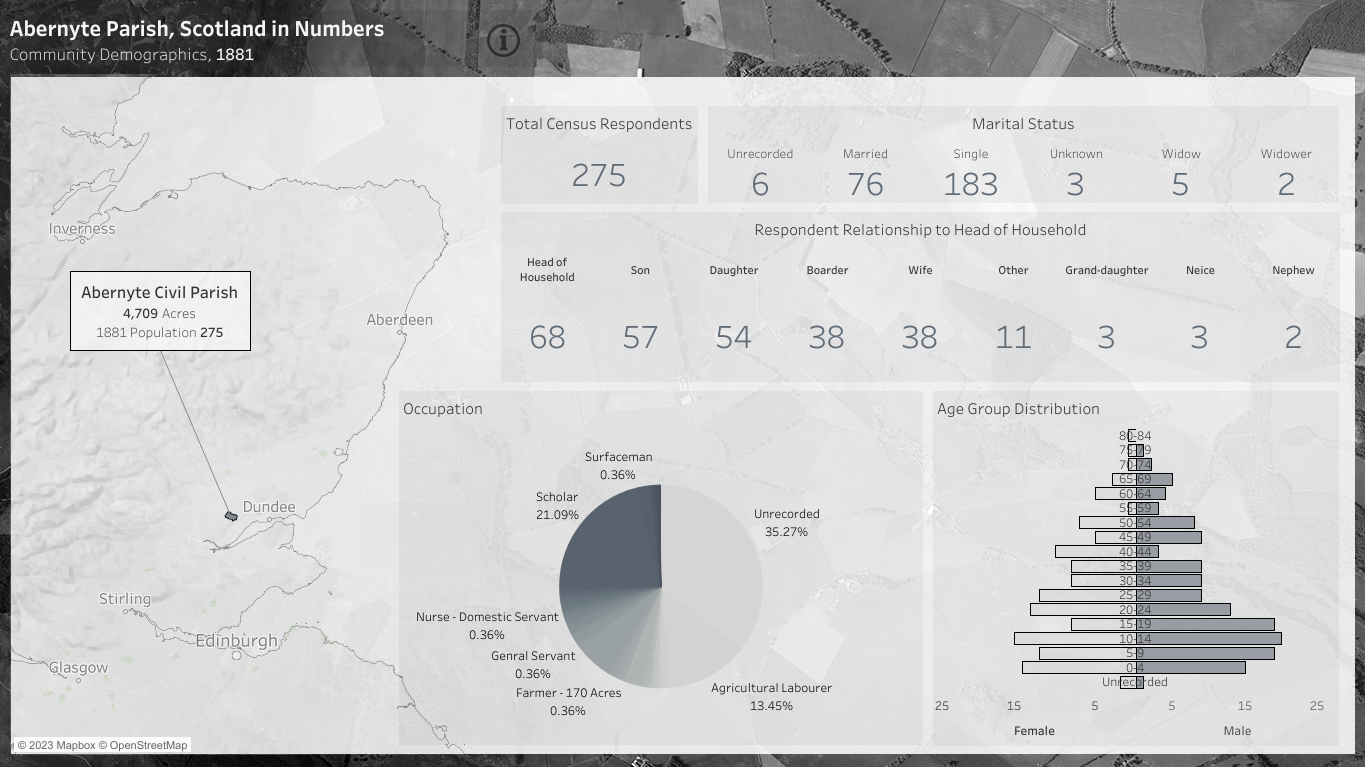


Abernyte in 1881

Here is a visualisation of the make up of the Parish of Abernyte at the time of the 1881 Census.

1881Census

Old Photograph - B953

While searching for items for the Archive we came across three intriguing old photographs. The images are of a group in mostly military garb in a car in the Abernyte area.

The location is no problem, as all residents of Abernyte will recognise this as the Glen Road or B953 Abernyte to Balbeggie Road mid way between Balloleys Wood and Tulloch Ard. Of course it would not have been known by its road number until after 1922. The width of the road has varied somewhat since the photo was taken, but not by that much!


Who the group are, what they are up to and when the photograph was taken is a much greater challenge. 

We can see the number plate clearly which tells us the vehicle was registered in Wimbledon in London.  Careful examination of the photos also reveals an AA badge . The shape of AA badges changed greatly over the years and this badge was first used in 1911 and changed again in 1918.

Working on the not unreasonable assumption that it was quite rare to have what is obviously an expensive motor car in the Glen Road in 1911ish and that the car therefore would be quite new, I think the photo will have been taken between 1911 and 1914.


All of the occupants, bar the chap perched on the boot, seem to be in military officers uniform. 


The remaining challenge: 

What is the make of the car?

Who are the group?

When was the photo taken and at what event?

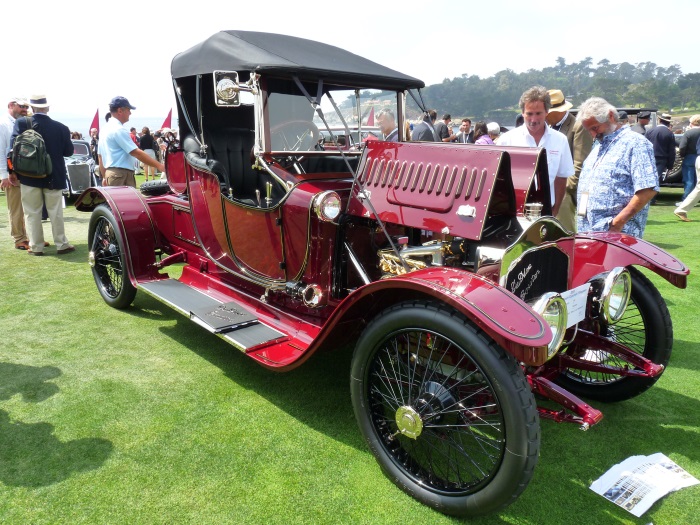
Firstly the car.  It is a 1912 De Dion Bouton Roadster which has a V8 engine producing 35 hp from a 6.1 litre displacement. 

1912 De Dion Bouton Roaster


This is an example in concourse condition at a show in America. Wow!


De Dion Bouton also made more military specification vehicles in the UK and went on to make various military vehicles during the World War I. The photographs we have show no grill name badge and a much more basic look, so this might be a military specified car.

Who are  the group and what were they up to?

Here we stuck lucky with an item in the Dundee Courier from March 1913 regarding a forth coming military exercise to be held in Abernyte on the 5th April 1913!  It was being organised by a 5th Black Watch Major and the detachments to take part were from the Royal Army Medical Corps under Major W.E. Foggie and the Army Service Corps under Caption C. W. Cochrane.

Also taking part, and this is the real show stopper, were aeroplanes attached to the Montrose Base who were to "locate the position of the invading or defending forces and relay the messages by flying as close as practicable to the ground and dropping them".  "Motor cyclists will keep in touch to convey the messages to the commanding officers"  The aeroplanes were to descend and land at Whitehills.  

According to the history of the Royal Flying Corps, aircraft were first used for aerial spotting on 13th September 1914. So what we have here, in our tale, is a very early attempt in aerial spotting which easily pre-dates the official history.  The Montrose Base was Britain's very first operational military airfield and was only opened in 1913 so the exercise at Abernyte must have been highly significant.

The Courier article goes on to say: " The usefulness of the aeroplane in war was amply demonstrated in the manoeuvers and the successful rush of a convoy from Dundee to a defending force at Whitehills, Abernyte pursued the "enemy" and after a hot chase had driven them into the sea"

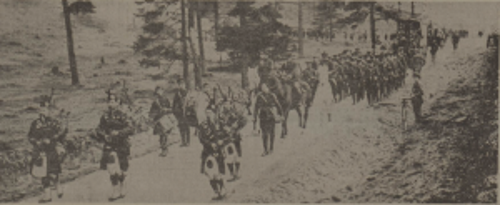
The Courier also carried a picture of the Black Watch marching through Whitehills to engage the "enemy".  This looks like it was taken on the straight between the existing steading and Den Cottage.

Convoy of troops march through Whitehills 1913


If you look at the rear view photograph of the original set of car photographs above, the officer on the left with the Glengarry cap is Major P. S. Nicoll ( no relation that I know of so far...I promise, it's all coincidence!) of the Black Watch. Zoom in and you can just make out a Red Hackle badge on his Glengarry. His left sleeve also has the three stripe insignia of a Major. Similarly the driver in the long right hand side view of the car has a Captain's insignia on his sleeve.  The gent in cilivilian clothing perched on the rear of the car is, we believe, Mr W. J. Dickie who was the landowner of Whitehills, Pitkindie  and Outfield at the time of the exercise.

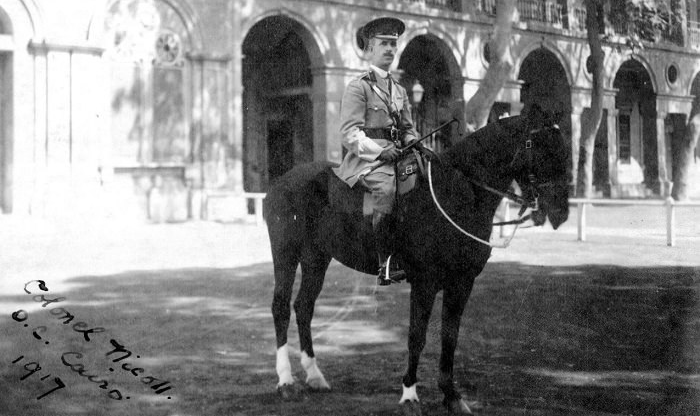
Major P.S.Nicoll went on to serve in the Great War and rose to the rank of Colonel in the Black Watch. We have traced a photograph, in the Dundee City archives, of him taken while serving in Egypt in 1917.

Colonel P.S. Nicoll, Black Watch

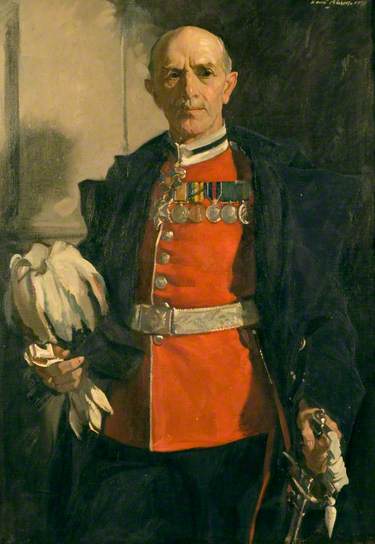
Colonel Nicoll resigned his commission in 1921 and died in 1942. There is a further painting of him in the McManus Gallery in Dundee.

Colonel P.S. Nicoll


 A superb wee snippet of local history all from three nearly anonymous photographs.  It is slightly disturbing to recall that this was all taking place in sleepy Abernyte before the conflict that engulfed all of Europe at the cost of so many lives.


  1. Sailing Barque - Abernyte
  2. Pitmiddle: a short history

Page 1 of 2

  • 1
  • 2

Account Deletion

If you wish to unsubcribe and delete your personal data from any of the services of Abernyte CiC, please click here.

Account Deletion

Abernyte Weather

Useful Links

  • Privacy Statement
  • Terms and Conditions
© 2005 - Onwards - Abernyte Community